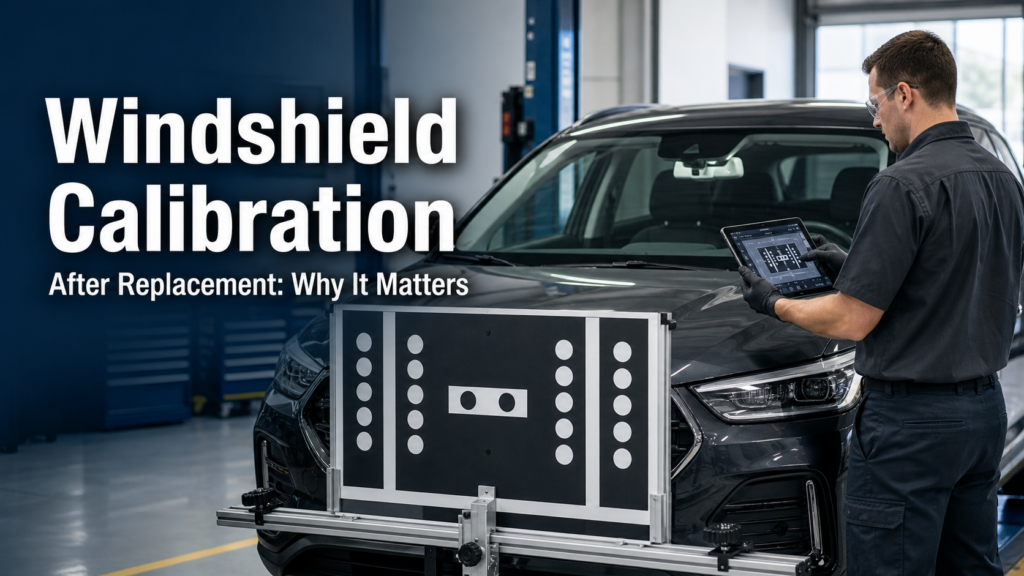
Windshield calibration after replacement is the precise alignment and adjustment of Advanced Driver Assistance Systems (ADAS) cameras and sensors mounted on or near the windshield to ensure proper functionality following windshield glass installation. This calibration process restores the camera field of view and sensor detection range to OEM specifications, enabling safety features like forward collision warning, lane departure warning, and automatic emergency braking to function accurately.
Why Windshield Calibration Matters After Replacement

According to the National Highway Traffic Safety Administration (NHTSA), ADAS technologies prevent thousands of collisions annually. When a windshield replacement occurs, even millimeter-level deviations in camera positioning or sensor orientation can cause safety system malfunctions. The windshield mounted camera and radar sensor require precise alignment to correctly identify lane markings, detect pedestrians, recognize traffic signs, and calculate distances to vehicles ahead.
Without proper windshield calibration after replacement explained and performed, drivers may experience false collision warnings, inactive lane keeping assist, or complete failure of collision avoidance systems. These malfunctions compromise vehicle safety and road safety, potentially increasing accident risk despite the presence of electronic safety features.
Key Characteristics of Windshield ADAS Calibration

Essential Calibration Components
Professional windshield calibration involves three critical elements that distinguish it from standard glass replacement:
- Precision Equipment: Calibration equipment includes laser alignment tools, diagnostic software, calibration target boards, and manufacturer-specific calibration targets that meet OEM calibration standards.
- Technical Expertise: Certified technicians must understand vehicle manufacturer specifications, electronic control unit (ECU) programming, and camera bracket alignment requirements specific to each make and model.
- Environmental Controls: Calibration procedures demand level surfaces, controlled lighting conditions, and specific spatial requirements—static calibration typically requires 20-30 feet of clear space in front of the vehicle.
- Quality Glass: OEM glass or compatible aftermarket glass with identical optical clarity and minimal windshield distortion ensures accurate camera aiming and sensor accuracy.
- Verification Testing: Post-calibration system diagnostics confirm proper installation, warning light reset, and elimination of system error codes before the vehicle returns to service.
How Windshield Calibration Works: The Complete Process
Static Calibration Procedure
Static ADAS calibration occurs in a controlled service center environment and follows these sequential steps:
- Pre-Calibration Assessment: The calibration technician uses diagnostic software to identify which safety systems require recalibration and checks for existing system error codes.
- Vehicle Positioning: The vehicle is placed on a perfectly level surface with tire pressures adjusted to manufacturer specifications and suspension at proper ride height.
- Target Setup: Calibration target boards displaying specific patterns are positioned at precise distances and heights according to factory calibration specs—typically 10-20 feet from the windshield camera.
- Camera Housing Adjustment: Technicians verify the mounting bracket and camera housing are properly secured, then initiate the camera alignment process through the vehicle’s electronic control unit.
- Software-Guided Calibration: OEM-specific diagnostic calibration software guides sensor positioning adjustments while the camera system “learns” reference points from the calibration target.
- Verification and Testing: System diagnostics confirm calibration accuracy, dashboard warning lights are reset, and automated safety features are tested for proper functionality.
Dynamic Calibration Procedure
Dynamic ADAS calibration requires on-road driving under specific conditions:
- Initial Programming: Technicians connect diagnostic equipment and initialize the dynamic recalibration process through the ECU.
- Road Testing: The vehicle must be driven on well-marked roads at prescribed speeds (typically 35-65 mph) for 30-60 minutes while the camera system and radar sensor self-calibrate using real-world inputs.
- Automatic Completion: The ADAS recalibration completes automatically once the system has gathered sufficient data about lane markings, vehicle spacing, and environmental conditions.
- Final Verification: Post-drive diagnostics confirm successful calibration verification and proper ADAS functionality.
Common Misconceptions About Windshield Calibration
Myth vs Reality: Calibration Requirements
Myth: Only luxury vehicles or newer models need calibration after windshield replacement.
Reality: As of 2025, most vehicles manufactured since 2015 equipped with forward-facing cameras, lane keeping assist, adaptive cruise control, or automatic emergency braking require mandatory calibration following windshield installation.
Myth: DIY windshield calibration after replacement is possible with basic tools.
Reality: Professional windshield calibration requires manufacturer-specific equipment costing $10,000-$50,000, proprietary diagnostic software, and extensive technical training. Attempting self calibration risks safety system accuracy and may void vehicle warranties.
Myth: Windshield replacement without calibration consequences are minor and only affect optional features.
Reality: Skipping recalibration necessity can disable critical collision prevention systems, cause ADAS malfunction after windshield replacement without calibration, and create legal liability if subsequent accidents occur due to non-functional safety features.
Myth: Insurance companies never cover calibration costs.
Reality: Comprehensive coverage typically includes windshield calibration when it’s necessary for safety system restoration, though separate charges for windshield calibration may apply depending on policy terms.
Static vs Dynamic Calibration: Understanding the Difference
| Aspect | Static Calibration | Dynamic Calibration |
|---|---|---|
| Environment | Indoor auto glass shop or service center | On-road driving conditions |
| Equipment | Calibration targets, laser alignment tools, diagnostic software | OBD-II scanner, manufacturer diagnostic software |
| Calibration Timeline | 1-2 hours in controlled setting | 30-60 minutes of specific driving patterns |
| Space Requirements | 20-30 feet of clear, level space | Well-marked roads with minimal traffic |
| Common Applications | Honda, Toyota, Subaru Eyesight calibration after windshield replacement, Mercedes windshield calibration service | BMW windshield replacement ADAS calibration, Tesla windshield replacement calibration procedure |
| Technician Involvement | Continuous supervision and adjustment | Initial setup, then automated system learning |
| Typical Cost | $250-$600 depending on system complexity | $150-$400 for drive cycle and verification |
Some vehicles require both static and dynamic calibration procedures sequentially. For example, Subaru Eyesight systems typically need static camera aiming procedure followed by dynamic recalibration to fully restore ADAS functionality.
Which Vehicles Need Calibration After Windshield Replacement
Manufacturer-Specific Requirements
Windshield camera calibration requirements by vehicle vary significantly based on the ADAS technologies installed:
Honda: Honda Sensing systems require static calibration for forward collision warning calibration after windshield replacement, lane departure warning, and adaptive cruise control recalibration. Honda windshield replacement calibration cost typically ranges $300-$500.
Toyota: Toyota Safety Sense equipped vehicles need static calibration targeting. Toyota windshield camera calibration requirements mandate precise sensor reconfiguration for parking assistance, blind spot monitoring, and pedestrian detection systems.
Subaru: Subaru EyeSight uses dual cameras requiring specialized calibration equipment. Both camera systems must achieve proper alignment and sensor positioning to restore night vision system and traffic sign recognition functionality.
Tesla: Tesla vehicles employ multiple cameras and sensors necessitating comprehensive recalibration using proprietary diagnostic software. Tesla windshield replacement calibration procedure includes camera aiming, radar recalibration, and system verification.
German Manufacturers: BMW, Mercedes, and Audi vehicles often require both static and dynamic calibration. Mercedes windshield calibration service cost averages $400-$700 due to complex sensor arrays and heads-up display recalibration needs.
Cost Factors and Insurance Coverage
Understanding Total Service Cost
The windshield replacement and ADAS calibration cost includes several components:
- Glass Replacement: OEM replacement glass costs $200-$600, while aftermarket windshield prices range $150-$400 depending on vehicle model.
- Calibration Fee: Static calibration averages $250-$600; dynamic calibration costs $150-$400; combined procedures may total $500-$1,000.
- Labor Costs: Windshield installation process requires 2-4 hours when including windshield adhesive application, curing time, and calibration procedures.
- Mobile Service Premium: Mobile calibration service availability adds $50-$150 to total costs for on-site convenience.
Insurance Claim Considerations
Most comprehensive coverage policies include glass damage repairs, but insurance coverage for windshield calibration varies. Contact your insurance company before service to verify whether calibration is included or requires separate approval. Some insurers classify ADAS recalibration as mandatory safety equipment restoration, while others consider it an additional service requiring prior authorization.
The insurance deductible may apply to the combined windshield replacement cost and calibration service, or calibration might be covered separately without deductible depending on policy language and state laws regarding windshield ADAS calibration mandatory requirements.
Safety Risks of Skipping Windshield Calibration
Understanding what happens if you don’t calibrate windshield after replacement reveals significant safety hazards:
False Safety Assurance: Dashboard displays may show ADAS features as active when they’re actually non-functional or providing inaccurate data due to sensor misalignment.
Collision Risk Increase: Misaligned forward-facing cameras cannot accurately calculate closing speeds or detect lane departures, negating the collision prevention system benefits that reduce rear-end collisions by up to 50% according to NHTSA data.
Automatic Emergency Braking Failure: Sensor malfunction prevents automated braking calibration systems from activating during critical moments, eliminating what the Auto Glass Safety Council (AGSC) identifies as one of the most effective collision avoidance technologies.
Legal Liability: Drivers involved in accidents after declining post-replacement calibration may face liability claims if investigation reveals non-functional safety systems contributed to collision severity.
Choosing a Qualified Calibration Service Provider
Certification Requirements for Technicians
When searching for windshield replacement with camera calibration near me or certified windshield calibration technician near me, verify these qualifications:
- Industry Certifications: Look for technicians certified by the Auto Glass Safety Council or holding manufacturer-specific credentials for brands like Honda, Toyota, or Tesla.
- Equipment Investment: Reputable shops maintain current calibration equipment meeting OEM specifications and update diagnostic software regularly.
- Warranty Coverage: Professional installations include warranties on both proper fitment and calibration accuracy, typically 12-24 months.
- Transparent Pricing: Quality providers clearly explain whether windshield replacement calibration is included in price or billed separately.
Dealership vs Independent Shop Calibration
Both dealerships and certified independent shops can perform proper calibration, though approaches differ:
Dealership Advantages: Direct access to OEM calibration standards, factory calibration specs, and genuine parts ensures compatibility. However, dealership services typically cost 20-30% more than independent alternatives.
Independent Shop Benefits: Certified installation facilities offering competitive pricing while maintaining calibration certification requirements for technicians. Many independent providers offer mobile service and faster appointment availability.
The cheapest place for windshield calibration after replacement isn’t always the best choice—prioritize certification, equipment quality, and warranty support over price alone to ensure structural integrity and safety compliance.
Frequently Asked Questions
Can I Drive Without Windshield Calibration After Replacement?
Technically yes, but it’s unsafe. The vehicle will operate, but automated safety features may malfunction or deactivate entirely. Drive only directly to a service facility for immediate calibration to minimize safety risks.
How Soon After Windshield Replacement Needs Calibration?
Calibration should occur immediately following windshield installation once the windshield adhesive has reached sufficient strength—typically 1-2 hours after installation. Some shops perform calibration during the safe to drive waiting period before customer pickup.
Does Every Windshield Replacement Need Calibration?
Only vehicles equipped with ADAS cameras or sensors mounted on or behind the windshield require calibration. Vehicles manufactured before 2015 without camera systems typically don’t need recalibration, though rain sensor and heads-up display equipped models may require adjustment.
Why Is Windshield Calibration So Expensive?
Calibration equipment costs $10,000-$50,000 per system, manufacturer software requires annual licensing fees, and technician training involves significant investment. These overhead costs, combined with the 1-3 hour service duration, drive the calibration fee structure.


